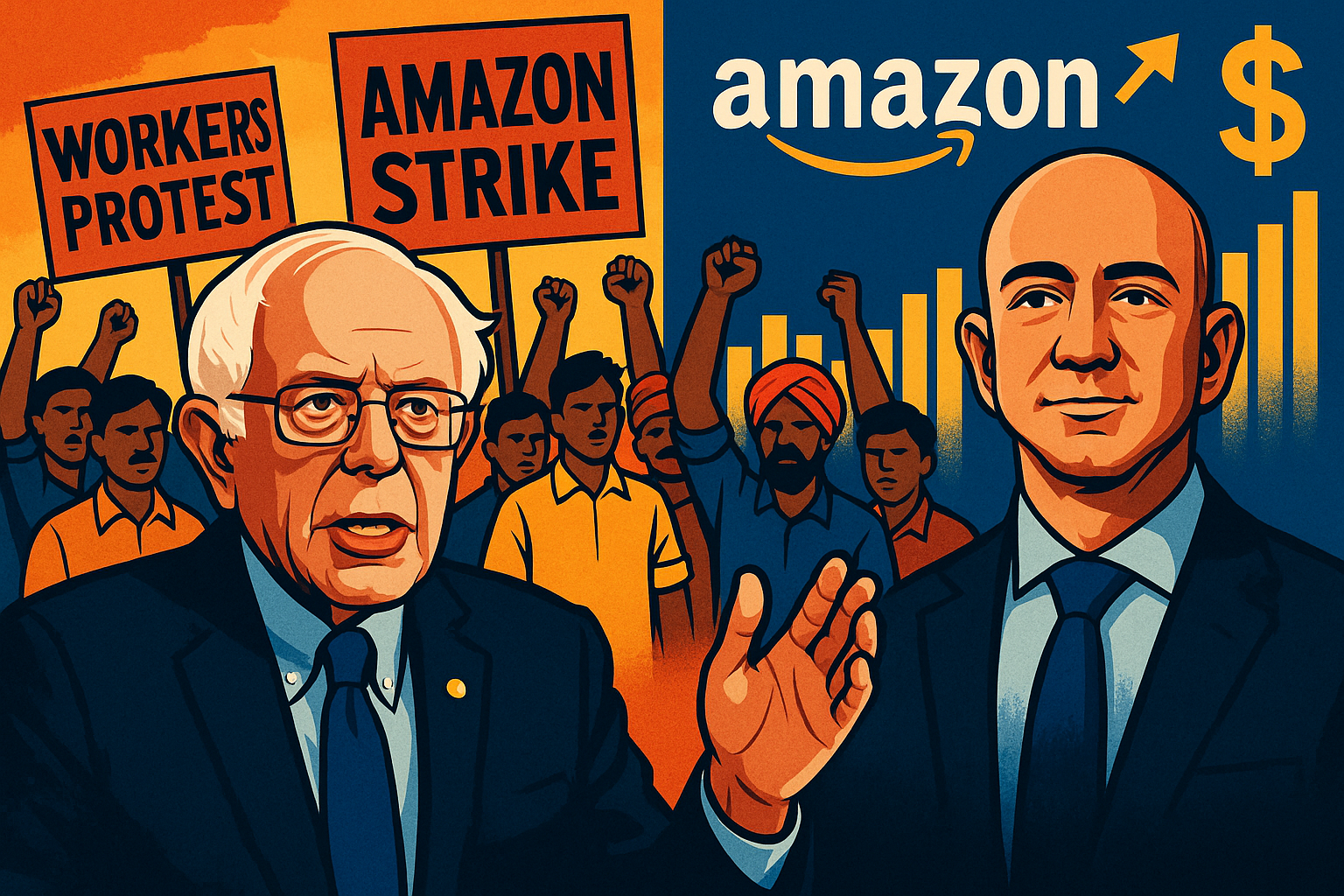
Worldwide labor unrest targeting Amazon has escalated, and U.S. Senator Bernie Sanders is adding his voice to the movement. Sanders publicly backed Amazon worker strikes across multiple countries — including India, where employee protests have intensified over working conditions and compensation. He pointed to the immense wealth of Amazon founder Jeff Bezos as evidence of what he calls a “deep imbalance” between corporate profits and frontline worker treatment.
Sanders Amplifies Worker Protests
Indian Amazon workers have staged demonstrations demanding better wages, improved job stability, and fair scheduling. As these actions spread globally, Sanders’ endorsement has brought renewed political attention to ongoing labor issues inside one of the world’s most powerful technology and retail companies.
He argued that Amazon’s scale and financial success should translate into stronger protections for workers worldwide, especially during peak shopping seasons when labor demands intensify.
Institutional Investors Increase Amazon Holdings
While worker unrest commands headlines, major financial players continue to see long-term value in Amazon’s stock.
Several firms — including Integrity Financial Corp WA, Meridian Management Co., Tredje AP fonden, Plato Investment Management Ltd, Ciovacco Capital Management LLC, and C2P Capital Advisory Group LLC — recently boosted their positions in Amazon.com, Inc. This broad accumulation underscores institutional confidence in Amazon’s diversified business model, from e-commerce and logistics to AWS cloud computing and AI innovation.
These increased holdings suggest that many investors remain bullish on Amazon’s growth trajectory, despite the short-term disruptions caused by labor activism and macroeconomic pressures.
A Split Market: Some Investors Explore Shorting Amazon Puts
Even as major firms raise their exposure, certain traders are leaning into more defensive or opportunistic strategies — such as shorting secured out-of-the-money Amazon puts. This strategy is often used by investors who are moderately bullish or neutral on a stock, aiming to generate premium income while expecting limited downside risk.
The presence of this strategy in the market indicates that not all investors see the same path forward. While long-term institutional accumulation signals confidence, options traders are positioning for potential volatility driven by labor tensions or shifts in broader market sentiment.
Balancing Worker Pressure and Market Strength
Amazon stands at a unique crossroads: growing pressure from global labor movements, amplified by high-profile voices like Bernie Sanders, paired with sustained — and in some cases increasing — institutional investor confidence.
The company’s response to worker demands, holiday-season logistics, and evolving market conditions will likely play a critical role in shaping Amazon’s near-term stock performance and long-term structural reputation.
For now, the story of Amazon remains one of dual narratives: rising worker activism challenging the status quo, and strong investor interest reaffirming belief in the company’s powerful economic engine.